
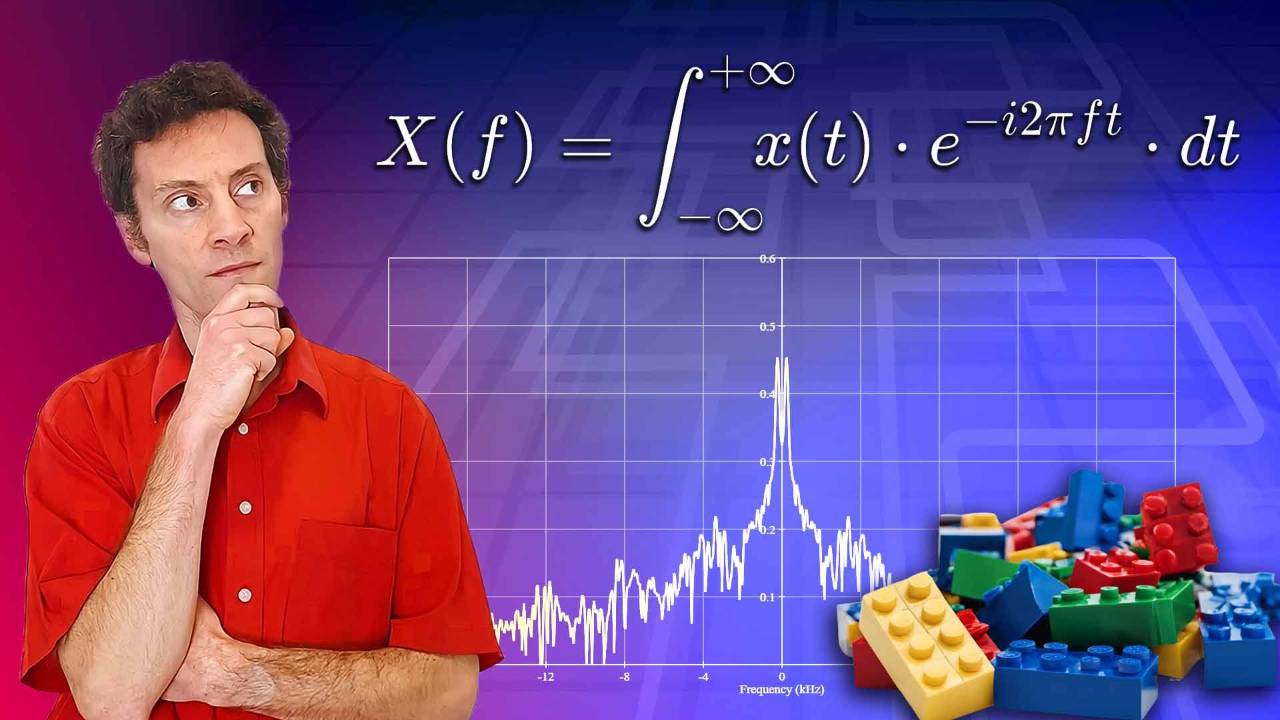
How the Fourier Transform Works
Have you ever wondered how your brain identifies a single violin in a full orchestra? Or how your phone compresses a high-definition photo into a tiny file? The answer lies in the Fourier Transform, one of the most powerful mathematical tools ever created.
While many textbooks teach this subject as a series of intimidating, abstract equations, this course takes a different approach. We move beyond the "math for math's sake" and provide a visual, intuitive, and comprehensive journey into how signals—from your voice to heat waves—are actually built.
What You Will Learn
- The Intuition of Sinusoids: Understand the fundamental building blocks of every signal. We’ll learn how a human voice is built out of simple sinusoids.
- Visualizing the Math: Stop staring at "strange-looking equations." We’ll break down the Fourier Transform equation until it makes complete sense, using triangles, circles, and the "Fourier Cube" to visualize complex dimensions.
- From Fourier Series to the Transform: Learn why the Fourier Series works for repeating signals (like a violin string) and how the Fourier Transform bridges the gap to analyze non-repeating signals (like a spoken word).
- Convolution Decoded: Master convolution—the operation at the heart of image recognition and machine learning—and learn the "shortcuts" that make these complex calculations possible.
- Lifetime access
- 30-Day Money Back Guarantee
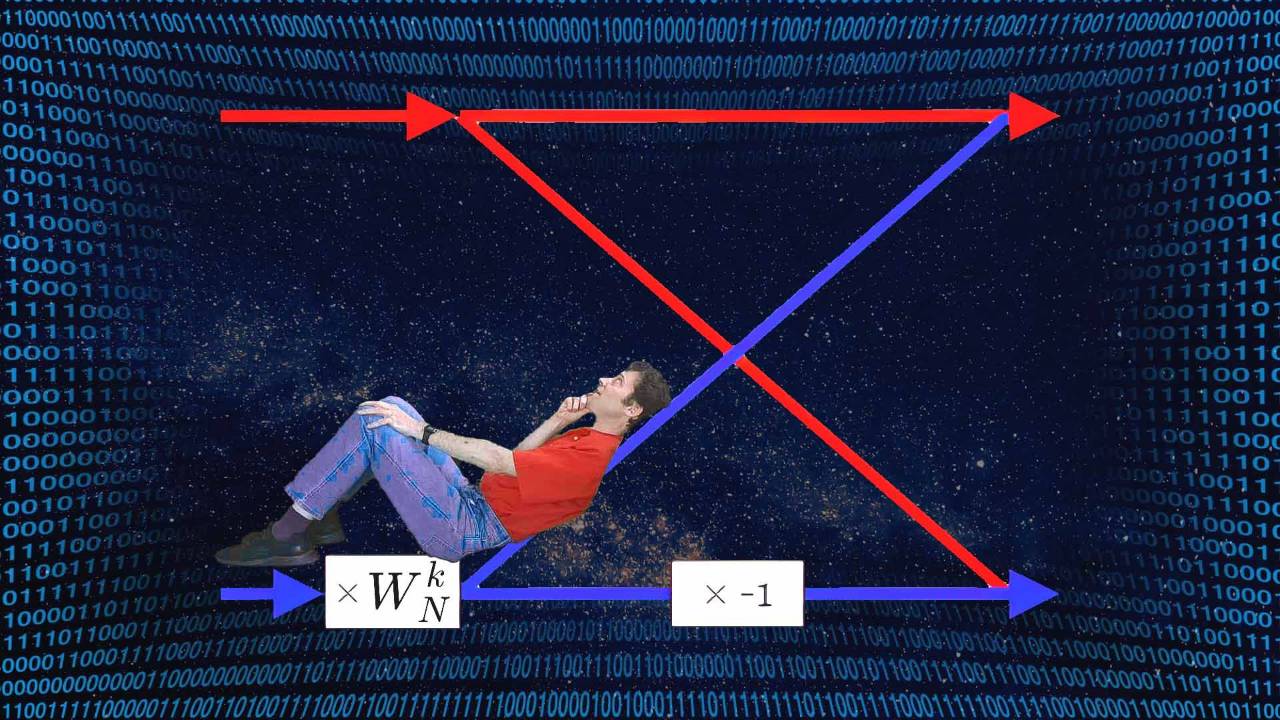
How the FFT Works
The Fast Fourier Transform (FFT) is the engine that drives modern technology. While the standard Discrete Fourier Transform (DFT) can be computationally overwhelming, the FFT revolutionized the field by finding a shortcut. This course takes you behind the scenes of this world-changing algorithm, showing you exactly how it works and how to build it yourself.
What You Will Learn
- The Power of Symmetry: Discover the hidden symmetries in sines and cosines that allow the FFT to perform calculations more than twice as fast as the standard DFT.
- The Divide-and-Conquer Strategy: Master the foundational logic used by Gauss, Cooley, and Tukey to break down massive problems into small, manageable tasks.
- Twiddle Factors & Butterflies: Demystify the "Butterfly Diagram" and learn how "Twiddle Factors" rotate data into complex dimensions to preserve information while saving processing power.
- Real-World Signal Interpretation: Learn to read the FFT output. Understand how to translate complex numbers into real-world frequency intervals and why "ghost" frequencies appear in the second half of the spectrum.
- Building Your Own Implementation: Move beyond "black box" libraries. We’ll guide you through writing your own FFT algorithm in JavaScript, from recursive logic to high-performance iterative frameworks.